


A new survey of 100 retail technology decision-makers reveals what's actually driving hardware decisions — and why the most important word in the conversation isn't "modern."
There's a version of the retail technology conversation the industry has been having for years. Retailers need to modernize. They need frictionless checkout, AI-enabled inventory, seamless omnichannel experiences. The technology exists. The only question is how fast they get there.
That's not what the data told us.
A survey of 100 U.S. retail technology decision-makers, spanning grocery, general merchandise, apparel, electronics, and department stores, tells a different story. Retailers aren't primarily focused on modernization. They're focused on managing risk, reducing disruption, and protecting the operational continuity of stores that cannot afford to go dark.
Innovation is somewhere on the list. It's just not near the top.
Understanding the difference is the most important thing a technology partner can do right now, especially given that only 14% of retailers currently rely on a third-party partner for deployment. That gap is the opportunity.
94% of Retail Hardware Refreshes Are Reactive, Not Planned
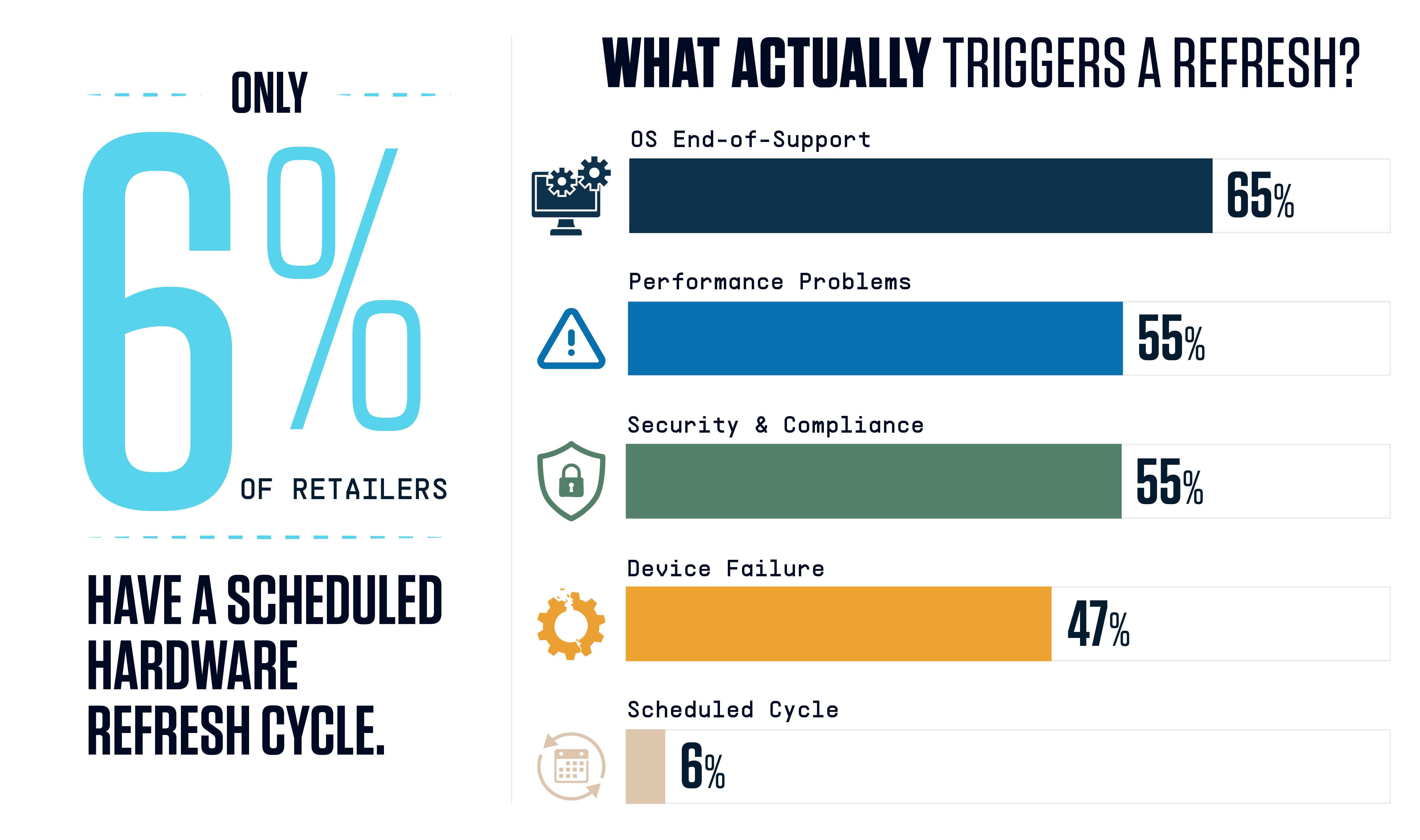
Ask a retailer why they're considering a hardware refresh, and the answers are almost uniformly reactive: OS end-of-support (65%), performance degradation (55%), security and compliance pressure (55%), device failures (47%).
Only 6% are refreshing on a proactive, scheduled cycle.
That number deserves a moment. Six percent. In an industry that has spent years talking about digital transformation and strategic investment, the overwhelming majority of refresh decisions aren't strategic at all. They're being made because something expired, broke, became a liability, or stopped working well enough to keep the store running.
For technology partners, this completely reframes the sales conversation. You are not selling modernization to a buyer on a transformation journey. You are selling risk mitigation to a buyer who is trying to stop hurting. The most valuable opening isn't "let me show you what's new." It's "let me show you what's expiring—and what we'll do when it does."
Your Trojan Horse
Build a hardware age map for your top accounts.
A simple assessment that maps a customer's current hardware age against known OS end-of-life dates. That's not a sales pitch. It's a service. And it opens doors that cold outreach won't.
IT Evaluates. Operations and Execs Close.
Here's a dynamic that explains a significant number of lost deals: IT controls the front end of the buying process, but IT doesn't always close it.
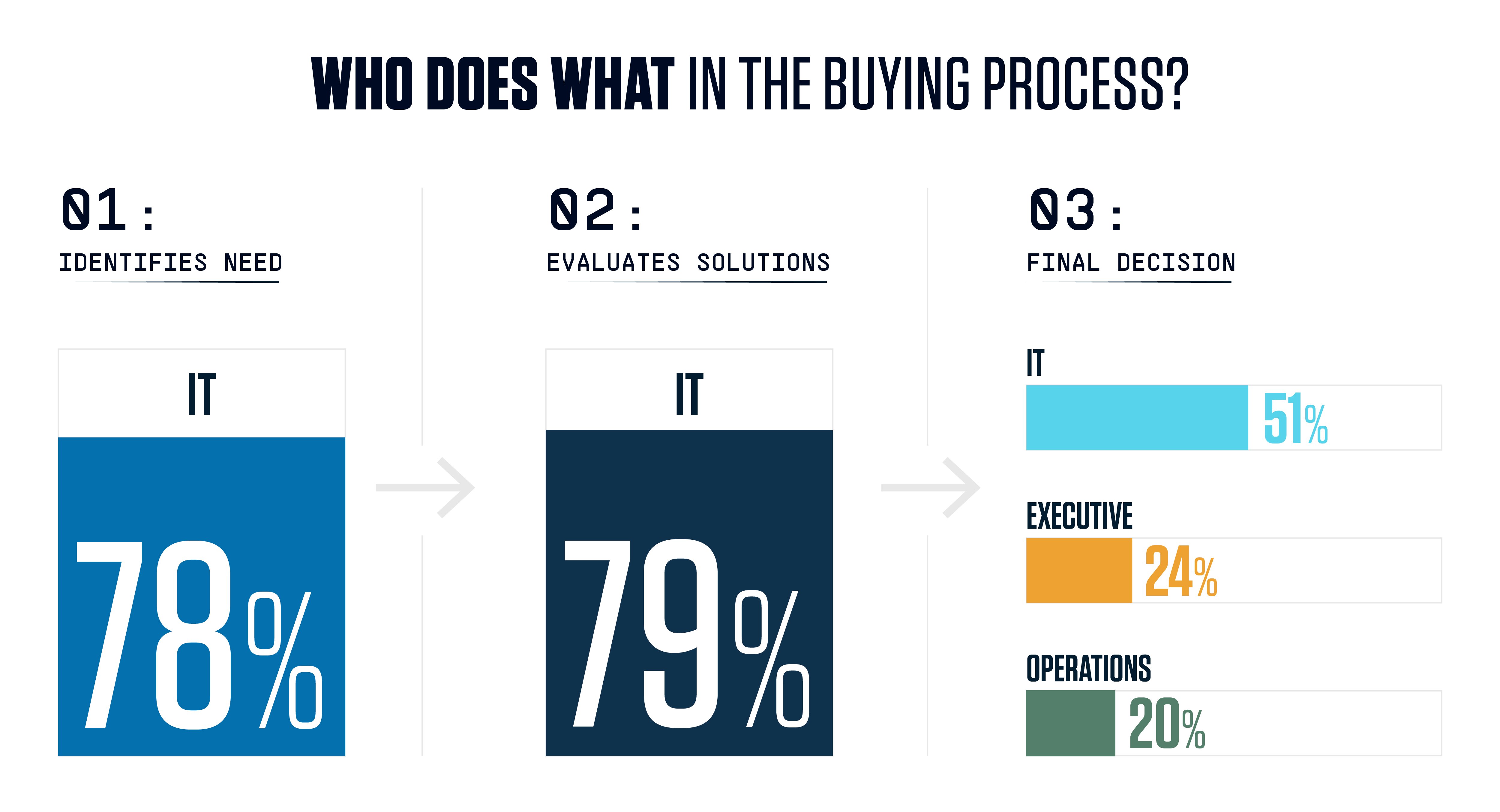
Seventy-eight percent of respondents say IT identifies when a refresh is needed. Seventy-nine percent say IT evaluates solutions. But only 51% say IT makes the final purchase decision. Operations leadership accounts for 20% of final decisions. Executive leadership accounts for 24%.
Selling to IT and winning IT's preference is not the same as winning the deal.
IT will evaluate you, prefer you, and advocate for you, and then the decision will go to a room where you've never made your case. Operations cares about store-level disruption. Executives care about cost justification and vendor risk.
The pattern intensifies by segment. In department stores, 46% of final decisions are made by executive leadership, nearly double the overall average. In general merchandise, operations makes the final call 44% of the time. In apparel, where respondents themselves skew heavily toward operations professionals, the buying process is almost entirely operations-driven.
The question to ask your IT contact: "When this goes to leadership for approval, who else will be in the room, and what are their biggest concerns?" That question alone changes the shape of a sales process.
SPONSORED MESSAGE
Longevity Beats ROI. Aesthetics Beat Vendor Reputation.
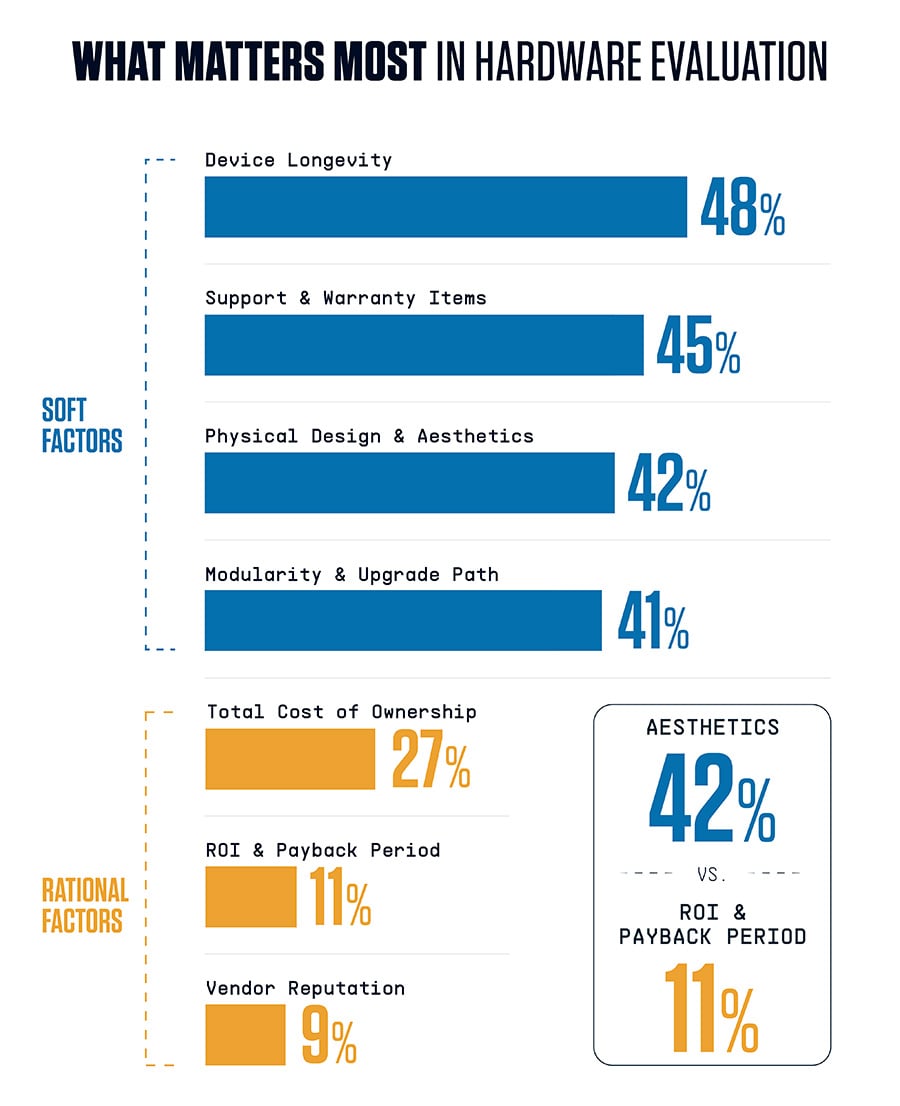
The top hardware evaluation factors are device longevity (48%), support and warranty terms (45%), physical design and aesthetics (42%), and modularity or upgrade path (41%).
ROI and payback period rank near the bottom at 11%. Vendor reputation comes in at 9%.
Two things stand out. First, buyers are buying time. Longevity, modularity, and serviceability dominate because the customer's primary goal is to not have this conversation again in three years. Lifecycle economics matter more than upfront specs.
Second: physical design and aesthetics rank higher than TCO, vendor reputation, and ROI.
Retail is a brand environment. The device on the checkout counter is part of the store experience. Forty-two percent named aesthetics a top-three evaluation criterion. It's not a peripheral consideration—it's a legitimate buying factor that most technology pitches treat as an afterthought.
The AI finding is worth noting: AI-enabled capabilities rank mid-range across device categories — 28% for POS terminals, 35% for mobile, 30% for kiosks.
As a digital priority overall, AI integration ranks eighth out of nine options. Retail buyers have heard the AI pitch. They haven't integrated it into their buying logic — with one notable exception. Apparel retailers named AI capabilities as a top POS feature at 67%, more than double any other segment. That window is real, but it's likely narrow as implementation reality sets in.
It's Not Budget. It's Bandwidth.
Perhaps the most practically important finding in the survey is also the most misread.
When retailers are asked what causes refresh projects to stall, the top answers are integration complexity (46%), staffing and resource constraints (44%), and downtime concerns (42%). Budget limitations rank at 21%.
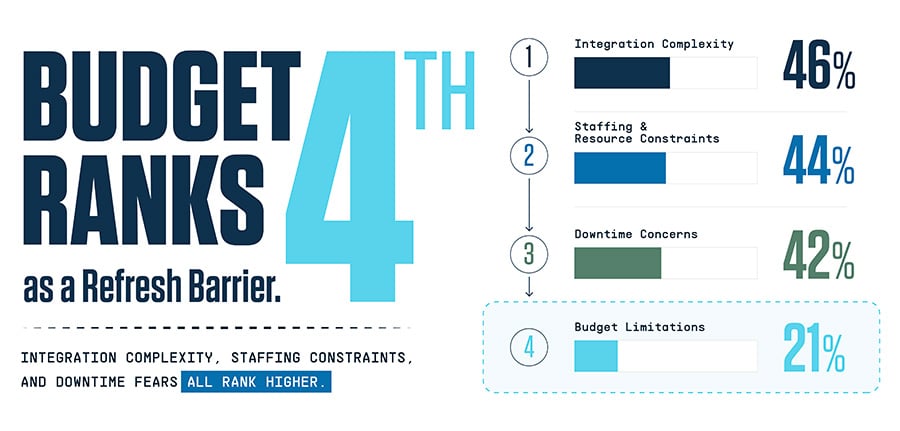
This is not a budget problem. It is an operational capacity problem.
The customer who hasn't refreshed in five years isn't stuck because the hardware costs too much. They're stuck because their IT team doesn't have the bandwidth to manage a rollout, because integrating new hardware is genuinely complex, and because the fear of stores going dark during deployment is real and well-founded. A retailer who lived through a bad rollout carries that memory into every subsequent purchasing conversation.
Discounting doesn't solve a staffing constraint. The customer's real question isn't "can I afford this?" It's "what happens to my stores while this is being installed, and who is going to manage the process?"
That's a services pitch, not a hardware pitch. Managed deployment, staging and imaging, rollout coordination, and post-deployment support directly address the top barriers to a purchase. The hardware is often almost secondary.
This gap is visible in the deployment data: only 14% of retailers currently rely on a third-party partner or VAR for deployment, despite staffing constraints being the second-highest barrier to refresh cycles.
Either managed deployment isn't being actively sold, or customers don't know it's available. Either way, it's the most under-leveraged revenue opportunity in the dataset.
The Pilot Is Not a Hurdle. It's the Sale.
One finding has no ambiguity: 100% of respondents pilot hardware before committing to a full deployment. Not one organization goes straight to purchase without a pilot. Seventy-two percent pilot across multiple locations.
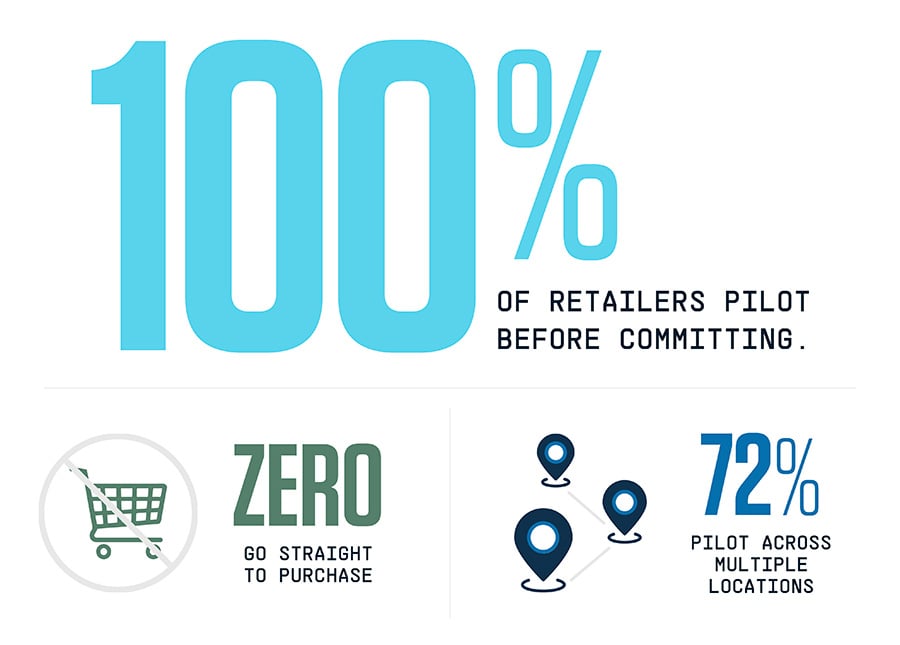
The pilot IS the sale. Win it deliberately, and you win the contract. Complicate it, and you're out regardless of your pricing.
The most effective approach: treat pilot enablement as a core competency. Offer to own staging, imaging, and initial deployment for the pilot phase. Establish clear success criteria before the pilot begins. Know who makes the go/no-go decision and what they'll be measuring. For enterprise accounts, get your hardware into their test environment before the formal evaluation starts, not after.
Pilot location strategy also varies.
Enterprise retailers use internal test labs. Mid-market customers favor new store locations. Grocery, Apparel, and Specialty retailers are more likely to pilot in underperforming stores, treating the pilot as a lower-stakes proving ground where almost any improvement registers as a win. Asking "would you prefer to start in a flagship or somewhere you have more room to experiment?" can surface a faster path to getting started than most salespeople expect.
Automation is the #1 Priority. Read It as a Labor Story.
The declared priorities for the next twelve to twenty-four months are specific enough to act on. Retailers named automation and reducing manual processes first (54%), followed by improving customer experience (43%), updating POS and checkout systems (40%), enhancing inventory visibility (40%), and expanding self-service (37%).
Checkout ranks as the most urgent modernization area when respondents stack-rank priorities.
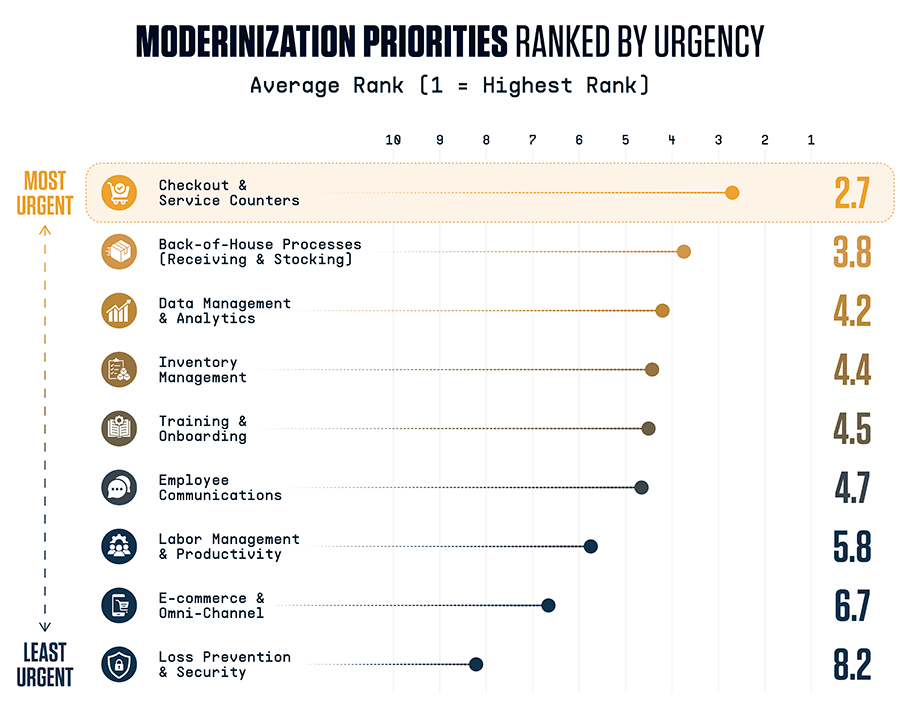
For partners selling POS terminals, self-checkout kiosks, or customer-facing displays, this is active demand, not latent interest.
The automation signal is the most important one, and it's worth reading carefully. Fifty-four percent naming "reducing manual processes" as a top priority is not really a technology story—it's a labor story.
Retailers are dealing with tight labor markets, high turnover, and sustained wage pressure. The technology they're buying is labor substitution and labor amplification. Every pitch that translates directly to "here is what your people will no longer have to do manually" is hitting a real economic nerve.
Segment-level priorities sharpen the picture further: Grocery is most focused on POS checkout modernization (56%).
General Merchandise leads on customer experience (69%) and data analytics (25%, nearly triple the average).
Specialty retailers are overwhelmingly focused on self-service expansion (75%) — by far the largest single-segment divergence on any modernization priority in the survey.
Three Conversations Your Sales Team Should Be Having Right Now
-
The Hardware Age Assessment
Ask your top accounts when their current hardware was deployed and what OS it's running. Map it against known end-of-life dates. This isn't a sales pitch — it's a service. And it surfaces urgency the customer may not have fully quantified yet. The retailer who realizes they have 47 terminals running an OS that expires in eight months is no longer a cold prospect.
-
The Deployment Services Conversation
The #2 reason refresh projects stall isn't budget — it's staffing. Your customer's IT team doesn't have the bandwidth to manage a rollout. Lead with managed deployment, staging, imaging, and rollout coordination as the answer to that problem. The hardware almost sells itself once you've solved the capacity question.
-
The Pilot Success Criteria Conversation
Every single retailer in this survey pilots before committing. Which means the pilot is the sale. Before it starts, get alignment on who makes the go/no-go decision and what they'll be measuring. A pilot without defined success criteria is a pilot you can lose on a feeling. A pilot with defined criteria is one you can win on paper.
Data sourced from the VDC Strategy in collaboration Elo and BlueStar (n=100 U.S. retail technology decision-makers). Respondents represent senior IT and operations professionals across grocery, general merchandise, apparel/footwear, electronics and appliances, department store, and specialty retail segments.