


There's a new term making the rounds in tech circles that every VAR should know: vibe coding.
Collins Dictionary named it their Word of the Year for 2025. Y Combinator reported that 25% of its most recent startup batch shipped codebases that were 95% AI-generated. And a platform called Lovable — which lets anyone build a working web app just by describing it in plain English — went from launch to $100M in annual revenue in under eight months.
This isn't a developer trend. It's a business trend. And it's one you should jump on.
What Is Vibe Coding, Exactly?
Vibe coding is the practice of building software by describing what you want in natural language, and letting AI write the code AND design the interface. You describe your app, iterate by conversation, and ship.
The term was coined by Andrej Karpathy, a co-founder of OpenAI, who described it as "fully giving in to the vibes" — trusting AI so completely that you don't even read the code underneath.
Think of it like this: instead of hiring a developer and explaining a brief, you're having a conversation with AI that is the developer. You say what you want, it builds it, you react, it revises.
Why Lovable?
There are several vibe coding tools (Bolt, Replit, v0), but Lovable has emerged as the most accessible and production-capable option for non-technical builders. Here's why it stands out:
- Full-stack out of the box. Lovable generates complete applications — frontend, backend database and user authentication from a single conversation. No separate hosting setup required.
- Three ways to build. You can use Agent Mode (AI builds autonomously), Chat Mode (collaborative, iterative), or via Visual Edits (a Figma-like drag-and-click interface — no prompting needed).
- Clean, exportable code. It outputs TypeScript and React. You own the code. You can export it to GitHub and take it anywhere.
- Built-in integrations. Native connections to Supabase (database), Stripe (payments), and GitHub.
- Pricing that makes sense. Free tier available. Paid plans start at $25/month.

Bottom line: if someone on your team can write a clear email, they can build a working web app with Lovable.
What Can You Actually Build?
This is where it gets interesting for VARs. The tools your customers used to need a developer for — or skipped entirely because of cost — are now buildable in a weekend. Here are examples directly relevant to your business:
For Internal Use
- Sales quoting tools — A custom interface for building quotes faster than your ERP allows, with margin visibility baked in
- Deal trackers — A lightweight CRM or pipeline board tailored to how your team actually sells, without paying for seats in a bloated platform
- Onboarding portals — A branded hub where new customers or new hires find everything they need in one place
- Inventory dashboards — Real-time views pulling from your data sources, without waiting on IT
- Service ticket intake forms — Smarter than a generic form, routing by issue type and customer tier automatically
For Customer-Facing Use
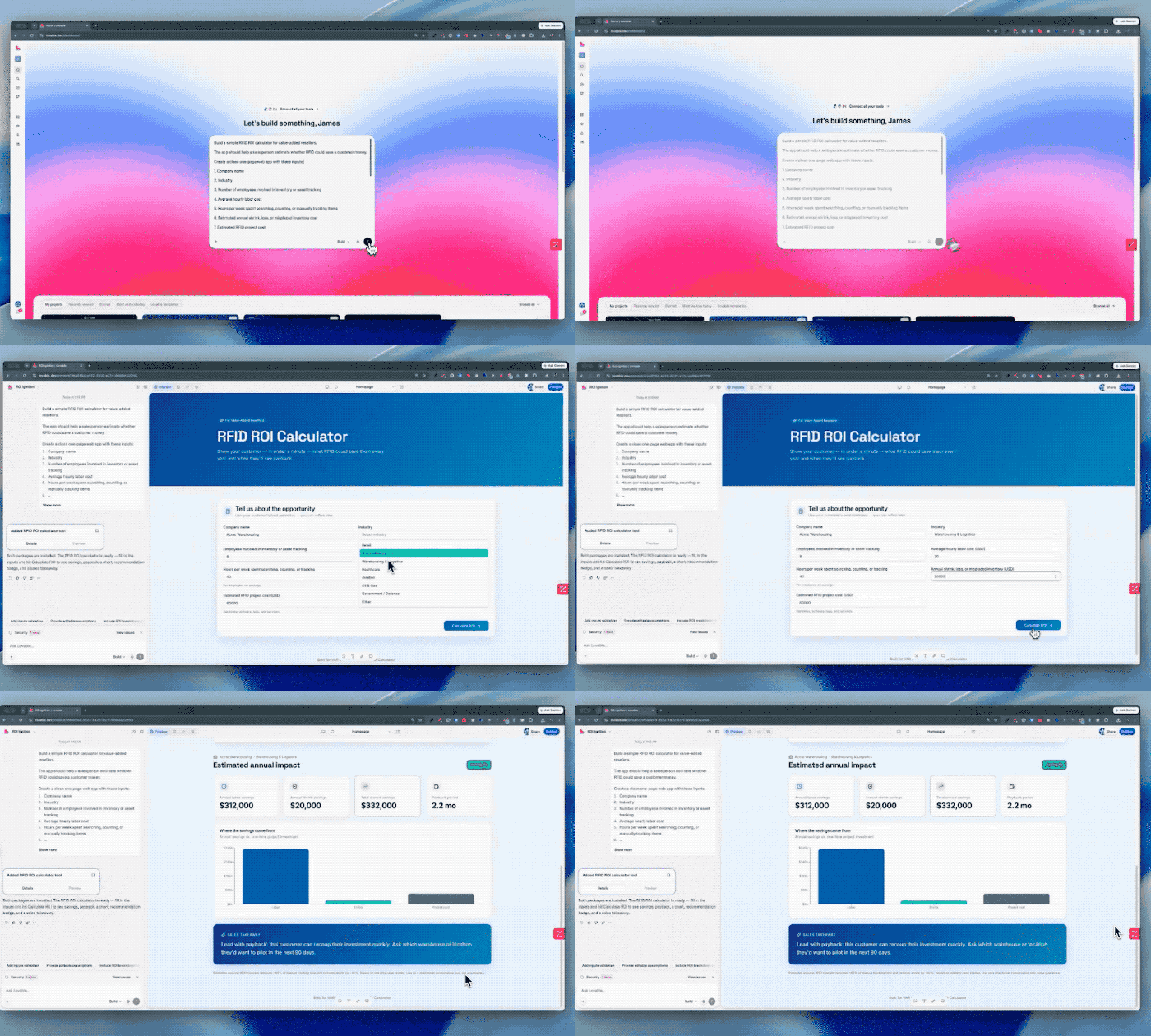
- ROI calculators — Interactive tools that let a prospect input their current setup and see projected savings from upgrading to your solution. These are proven lead-gen tools and they're now buildable in hours.
- Product configurators — Let customers spec out a solution (hardware, software, service tiers) and get an instant quote or recommendation
- Self-service portals — Give customers a branded hub to submit tickets, check order status, or access documentation without calling in
- Assessment tools — "Where does your business stand?" quizzes that score a prospect and recommend a solution tier — great for trade shows and campaigns
Why Should VARs Care Right Now?
Most VARs operate lean. There's not always a developer on staff, limited budget for software, and rarely time to evaluate whether a $400/month SaaS tool is actually worth it. Vibe coding changes that calculus in three concrete ways:
-
Build what you need instead of paying for it (or going without). Tools that used to cost $10,000–$20,000 and months of back-and-forth are now a weekend project. That internal quoting tool, that customer portal, that unified ops dashboard — they're all now within reach.
-
Unify your data without a big IT project. Most SMBs (including VARs) run on a patchwork of disconnected systems. Getting a single view has typically meant expensive integrations or manual exports. Vibe coding makes it practical to build a lightweight dashboard that pulls from your key sources via API into one place your team actually uses.
-
Prototype new offerings before you commit to them. Thinking about a new managed service or vertical? Build a working demo and put it in front of a prospect before you've spent anything on building it for real. It's the lowest-cost way to validate whether something is worth pursuing.
The Watch-Outs: Real Risks You Shouldn't Ignore
Vibe coding is powerful, but it's not without pitfalls. Iif you deploy it carelessly, the consequences can be serious. Here's what to watch for:
Security vulnerabilities are real
Research from multiple independent studies has found that AI-generated code contains security flaws at significantly higher rates than human-written code. In some analyses, 2-3x more vulnerabilities. A scan of 5,600 vibe-coded apps found over 2,000 vulnerabilities, including 400 exposed API keys and credentials sitting in the open. Lovable specifically had a documented incident in 2025 where 170 customer-built apps had misconfigured databases that exposed personal information.
Never put vibe-coded apps in front of real customer data without a security review. Treat it like any unaudited third-party tool.
"It works" is not the same as "it's ready for production"
Vibe-coded apps are great for prototypes, internal tools, and low-stakes customer-facing tools. They struggle under heavy load, can have inconsistent behavior, and the person who built it often can't explain what the underlying code does.
Be honest about what you're building and for whom. An internal quoting tool? Go for it. A tool handling customer PII or payment data? Get a developer involved in review.
Shadow AI is the new shadow IT
The same research that flagged security issues also flagged something else: business teams are deploying vibe-coded apps without IT review, compliance checks, or audit trails. A marketing manager builds a lead tool. A sales rep deploys a customer portal. Nobody in IT knows it exists. IBM's 2025 Cost of a Data Breach report found that "shadow AI" added an average of $670,000 to breach costs.
Establish a simple review process before anything customer-facing goes live. It doesn't need to be bureaucratic — it just needs to exist.
Hallucinated dependencies are a real thing
AI coding tools sometimes recommend software packages that don't actually exist, or reference outdated libraries with known security holes. Malicious actors have started registering fake package names matching common AI hallucinations, waiting for developers to install them.
If a developer or technically savvy team member isn't reviewing what Lovable generates before you deploy, you're taking on unknown risk.
How to Start (This Week)
You don't need to go deep on day one. Here's a practical on-ramp:
- Sign up for Lovable's free tier at lovable.dev and spend an hour building something low-stakes — an internal tool, a mock-up of a customer configurator, anything.
- Pick one internal problem your team complains about. Build a simple tool for it. Share it internally. Get feedback.
- Identify one customer-facing opportunity — an ROI calculator or configurator that would help you win a specific deal or vertical. Build a prototype to show in your next customer conversation.
- Loop in someone technical for a gut-check before anything touches real customer data. It doesn't have to be a full audit — just a sanity check.
The Bottom Line
Vibe coding is a practical (magical?) tool that lets business-minded people ship working software in hours instead of months. For VARs, it represents a real opportunity for building alignment-driving internal tools as well as customer-facing web apps to help prospects through their purchasing decisions.
Lovable is the most accessible entry point. The risks are real, but manageable, and the upside is significant.
The VARs who experiment now will be the ones writing the playbook a year from now.
BlueStar is committed to keeping our VAR community ahead of the curve on tools, trends, and technology. Download our 12-point pre-launch checklist for vibe coded apps.