


Executive Summary
We surveyed 100 retail decision-makers and found that shrink is no longer a background concern—it's reshaping technology investments and store operations.
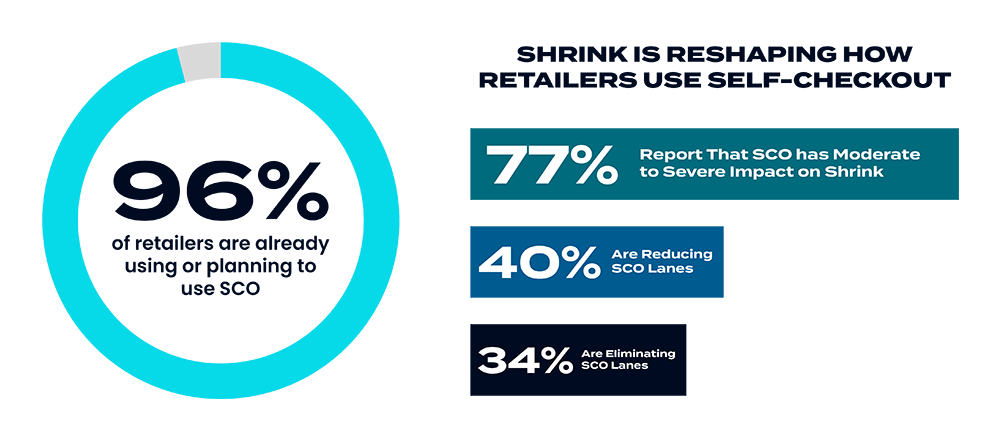
Self-checkout isn't being abandoned, but 74% of retailers are either eliminating or reducing SCO lanes due to shrink concerns. The buying authority has shifted dramatically: 54% of final approvals now come from executives, while IT accounts for just 3%.
What VARs must do now: Package self-checkout tech with multi-layered security, lead sales conversations with executives and operations (not IT), and position technology as operational stability tools that deliver margin protection and labor efficiency.
Retailers need four things: help fixing self-checkout, coverage solutions for thin staffing, real-time inventory visibility, and unified systems that connect their existing tech stack.
Read time: 9 minutes for full article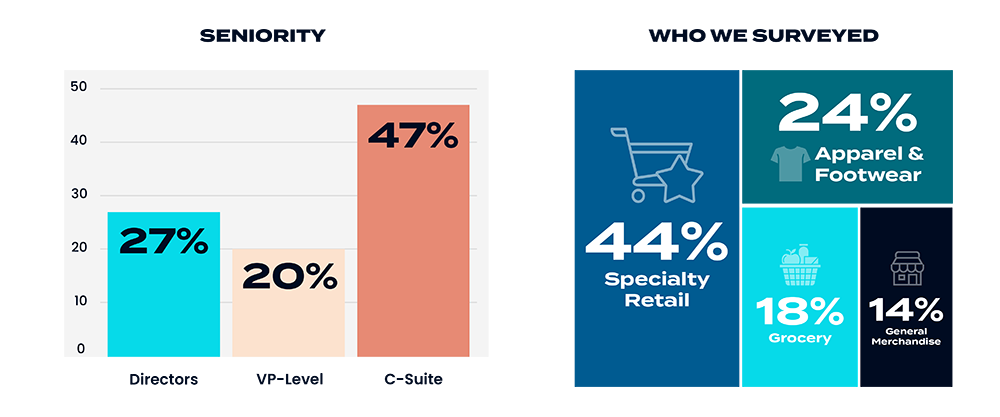
Who We Surveyed
In collaboration with VDC Research, we surveyed 100 retail leaders spanning grocery (18%), apparel and footwear (24%), general merchandise (14%), and specialty retail (44%).
Respondents represented organizations ranging from single-location operators to chains with 1,000+ stores, with the largest share (25%) operating between 10 and 100 locations. Decision-makers were strongly represented, including C-suite executives and owners (47%), VP-level leaders (20%), and directors overseeing operations and loss prevention (27%).
This ensures the insights reflect real buying influence, not just day-to-day IT users.
What the Data Reveals
Self-Checkout Has Become a Risk-Management Story
Self-checkout has become nearly ubiquitous—96% of retailers are already using or planning to use SCO. Yet enthusiasm has given way to caution. 77% report that self-checkout has a moderate to severe impact on shrink, and a meaningful number are actively pulling back: 34% are eliminating self-checkout lanes entirely, while 40% are reducing them.
This is a major signal to VARs: selling self-checkout as "faster checkout" or "better customer experience" is no longer sufficient. Retailers now expect any SCO deployment to come with built-in controls and accountability.
Shrink at Self-Checkout Is Behavioral, Not Accidental
The most common self-checkout shrink behaviors: 71% hiding items behind or under others, 52% barcode switching, 49% item pass-around, and 49% unintentional user errors.
No single technology addresses all of these scenarios. Weight checks alone fail. Cameras alone create false positives. Human oversight alone doesn't scale. For VARs, this means the winning offer is not a product—it's a layered system.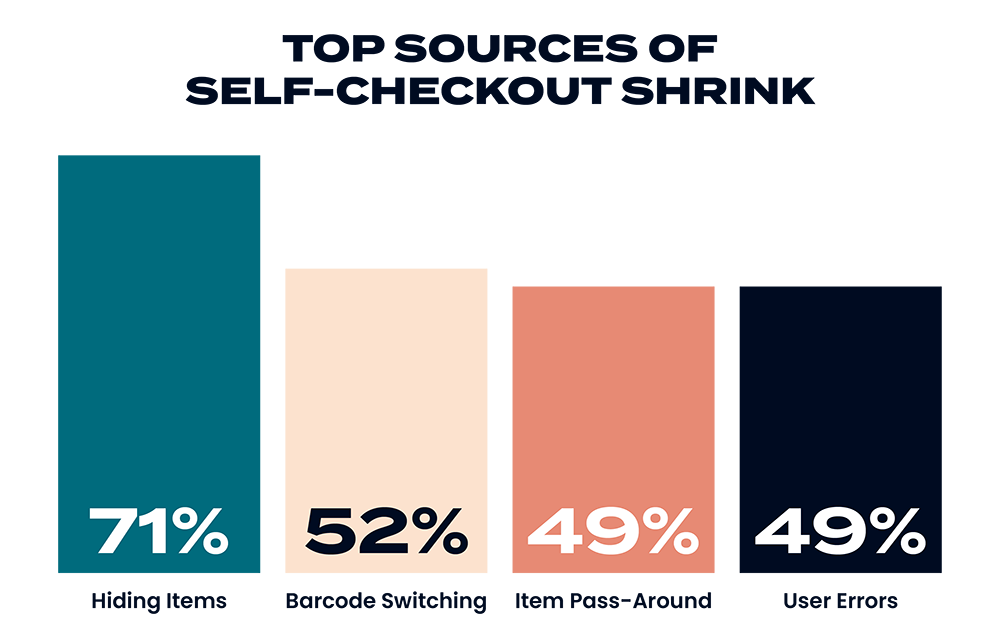
RFID Is Being Bought for Operations, Not Loss Prevention (At First)
84% of retailers report using item-level RFID, but only 28% cite loss prevention as the primary driver. Instead, they're buying RFID to improve inventory accuracy (68%), supply chain visibility (63%), and streamline workflows (60%).
For VARs, the takeaway is clear: lead with operational ROI, then expand into Loss Prevention. Once retailers see inventory benefits, they become receptive to exit alerts, predictive loss patterns, and faster restocking of stolen items.
Shrink Is as Much Internal as It Is External
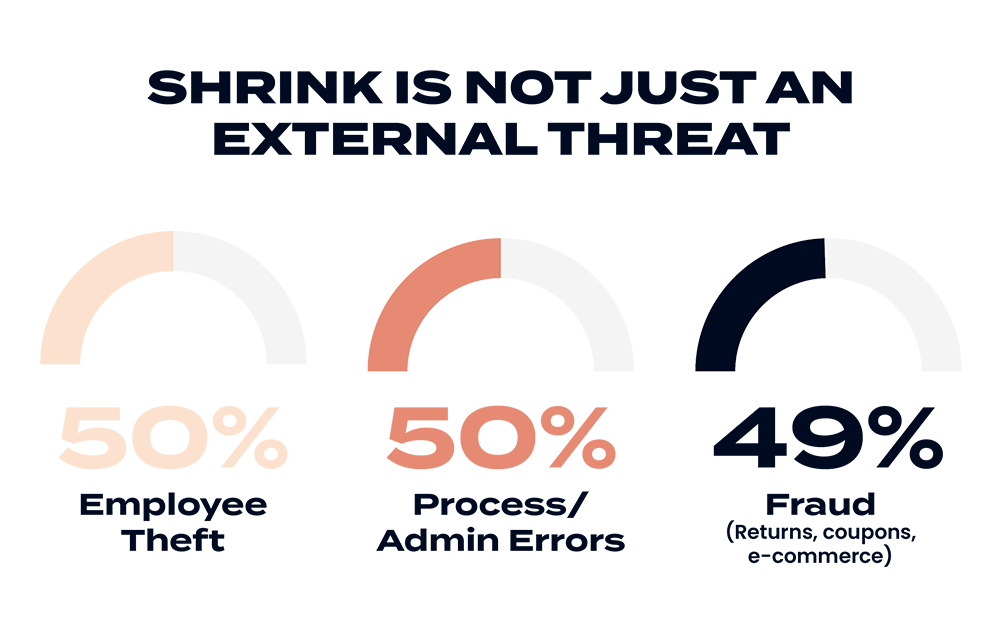
Shrink is not driven solely by organized retail crime. Top contributors include employee theft or dishonesty (50%), administrative and process errors (50%), and fraud related to returns, coupons, or e-commerce (49%).
This reframes shrink as a visibility and process problem, not just a security one. VARs that sell only deterrence miss the broader opportunity to sell insight, reporting, and operational control. Retailers also face staffing gaps, prompting them to adopt automation, remote monitoring, and simpler workflows that don't require additional headcount.
What VARs Should Bring to Market
Below are ready-to-sell, bundle-friendly offerings based directly on what retail leaders said they need.
Offer 1: The Self-Checkout Hardening Kit
A simple bundle that fixes the top SCO weak spots without requiring retailers to rip out lanes.
What's inside: Overhead + side cameras for full lane coverage, AI/computer vision for missed scans and item hiding, rules-based prompts for attendants (basket limits, random audits), and POS exception reporting tied to video clips.
Why it sells: It gives retailers a fast way to cut shrink without removing SCO lanes, which most don't want to do. It addresses the behavioral shrink patterns (hiding, switching, pass-around) that plague SCO operations and positions SCO as a managed risk rather than an uncontrolled liability.
Offer 2: Automation-to-Coverage LP Package
Helps stores fill staffing gaps without adding payroll.
What's inside: High-risk zone mapping (entry, beauty, liquor, electronics, self-checkout), smart cameras + alert tiers (low, medium, high), remote monitoring add-on for nights/weekends, simple mobile alerts for floor staff.
Why it sells: Retailers are desperate for coverage without extra headcount. This package extends visibility across the store even when teams are thin. It turns technology into a force multiplier for existing staff and provides the automation retailers need to address staffing shortages.
Offer 3: RFID + Loss Prevention Sync
Focuses on RFID as a real-time shrink and availability tool, not just an inventory counter.
What's inside: Item-level RFID tagging for high-risk or high-value categories, RFID POS readers + exit portals, automatic stolen-item identification, cycle count automation (daily or weekly).
Why it sells: This creates a clear expansion path: start with operational ROI (inventory accuracy, supply chain visibility), then layer in loss prevention capabilities as trust and adoption grow. Retailers want to know which items walked out, when, through which exit, and how fast they can restock. This bundle answers all of those questions and helps improve inventory accuracy, omnichannel fulfillment, and supply chain visibility.
Offer 4: The Loss Prevention Control Loop
A full-store approach that blends sensors, video, RFID, and POS analytics into one unified workflow.
What's inside: Alerts that combine camera + POS + RFID signals, one dashboard for store and district leaders, rules-based "If X Then Y" escalations, and monthly health + tuning reports.
Why it sells: Retailers don't want five dashboards. They want one answer to "What happened?" This package positions the VAR as the integration layer that interprets multiple data streams. It turns disparate systems into a continuous loop: Detect → Confirm → Alert → Act → Learn. It also addresses the reality that retailers are combining technology with process changes—adding AI and attendants simultaneously, not choosing one over the other.
SPONSOR MESSAGE
How VAR Sales Teams Should Adjust Their Sales Motion
Stop Leading with IT. Start Leading with Executives and Operations.
Retail buying authority has shifted dramatically:
- 47% say executive leadership most influences evaluations
- 54% say executives make the final approval
- IT accounts for just 3% of final budget authority
Sales motion shift: Lead conversations with margin protection, labor efficiency, and operational risk. Equip LP teams with proof, but anchor the story in executive outcomes. Bring IT in later as validators and integrators, not primary champions.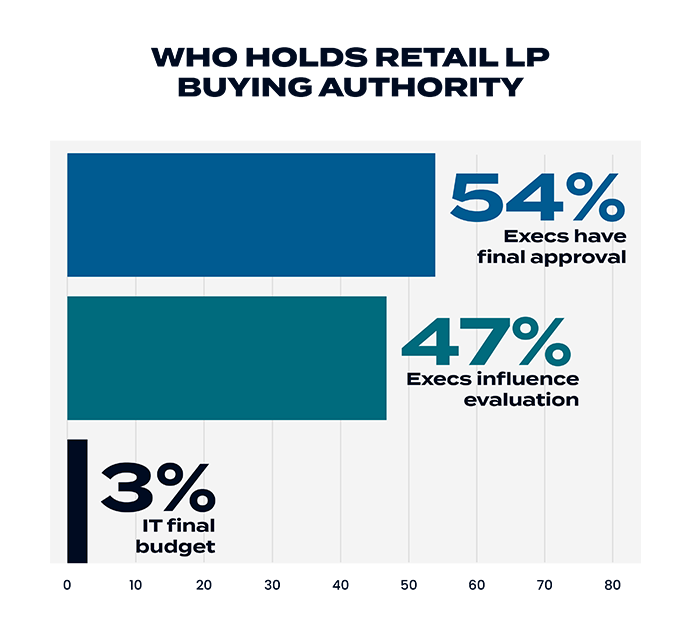
Lead with Business Outcomes, Not Tech Terms
The people who approve LP tech care about fewer missed scans, better coverage with the same staff, accurate inventory, higher on-shelf availability, and safer stores.
Less effective: "AI-powered video analytics with real-time anomaly detection."
More effective: "Cut missed scans by 30–50% in 60 days while maintaining customer flow."
Frame Shrink as an Operations Problem with Financial Consequences
Retailers are responding to shrink by increasing AI usage, adding human oversight, limiting SCO use, and redesigning workflows. Shrink is no longer a narrow LP concern—it is disrupting store performance.
Sales motion shift: Replace "loss prevention" language with "operational stability." Use metrics retailers already track: OOS rates, inventory accuracy, labor hours. Position solutions as ways to restore predictability, not just stop theft.
Message that lands: "Shrink is lost product. Lost product means empty shelves. Empty shelves mean lost sales."
Sell Operating Models, Not Just Technology
Retailers are combining technology with process changes. This creates a massive opportunity for VARs who can sell how systems are run, not just what systems are installed.
Sales motion shift: Include staffing models, exception playbooks, and KPIs in proposals. Set expectations around tuning, optimization, and iteration. Make services a core part of the offer, not an add-on.
Bring Templates and Playbooks to the Table
Retailers want quick wins, not giant installs. VARs should always bring: a 90-day pilot plan, a simple ROI worksheet, a lane hardening checklist, a heat map playbook, before-and-after metrics from similar stores, video clips showing actual problem behaviors, and clear cost ranges. These build trust fast.
When selling, remember that decisions are often centralized. Store-level champions need ammunition to sell upward. Give them 1-page executive summaries, comparison metrics, and video evidence. Your job isn't just to sell to the retailer—it's to equip them to sell internally.
The Takeaway for VARs
The VARs who win in retail over the next 12–24 months will:
- Package complete systems, not individual devices
- Lead with operations and margin impact, not features
- Sell first to executives and operations, not just IT
- Treat self-checkout as a managed risk, not a guaranteed win
Shrink is forcing clarity across retail. VARs who adapt both their offerings and their sales motion to that reality will be the ones retailers trust next.
If you can deliver on what retail leaders told us they need—"Help us fix self-checkout," "Help us cover the floor with the staff we have," "Help us see our inventory in real time," and "Help us tie all this together"—retailers will lean in.